
 Open Client Check
 Open COC / ESC
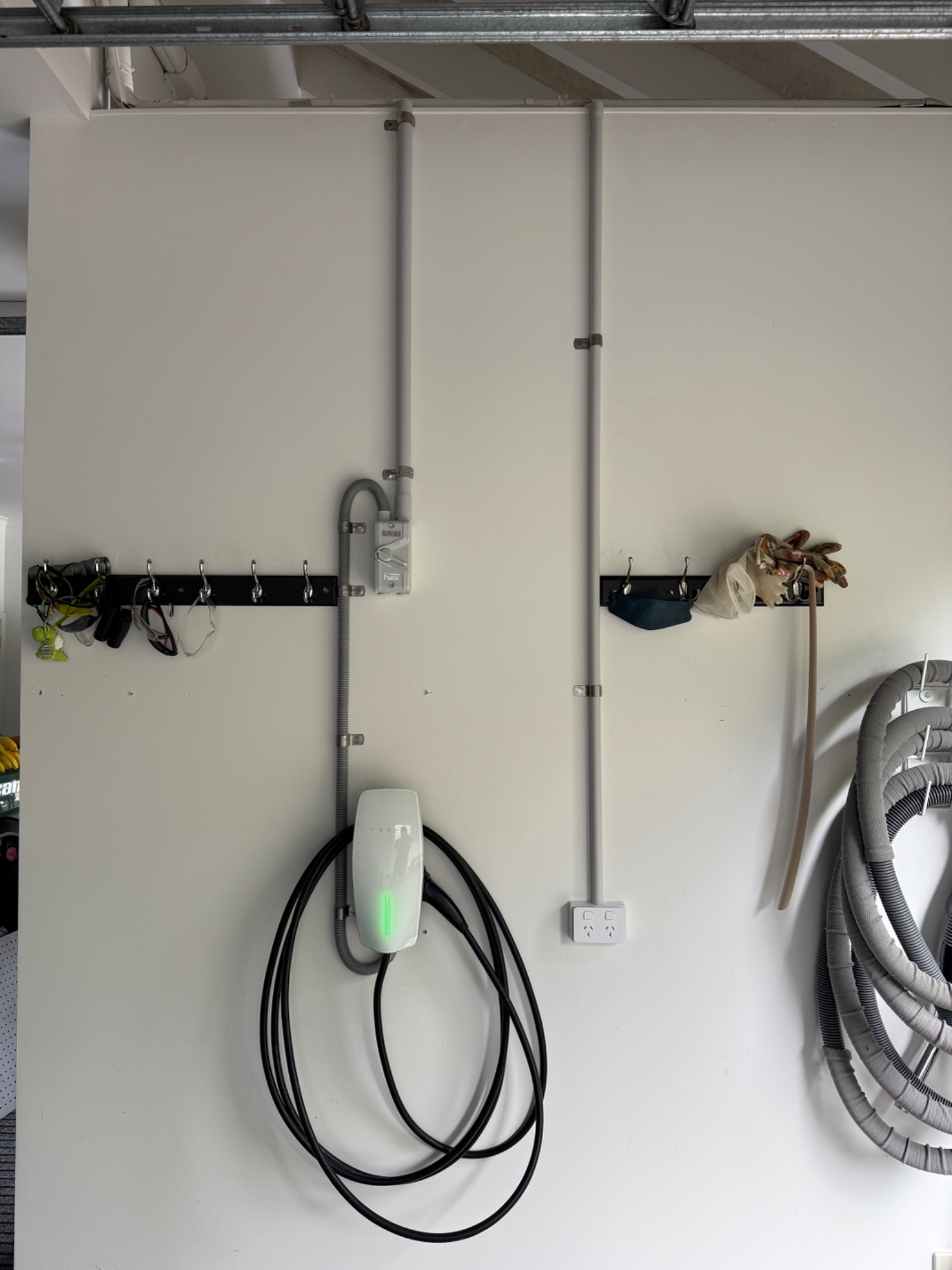
A home EV charger checklist starts at the house: where the car parks, where the switchboard is, what the supply and the board can take, and which charger you want. A wall charger runs on its own dedicated circuit from the switchboard, so the answers decide the cable route, the work at the board and the quote. In Auckland, our home EV charger installation includes the dedicated circuit each charger needs, and we install chargers at workplaces too.
The checklist
| Check | What to look at | Why it matters |
|---|---|---|
| Parking spot | Where the car parks, and which side its charging port is on | The charger goes where its cable reaches the port without lying across a path |
| Mounting wall | A garage wall, a carport post or an outside wall | A charger mounted outdoors has to be made for outdoor installation |
| Distance to the switchboard | The route from the board to the charger: through walls, the ceiling, underfloor or underground | A longer run needs more cable, and may need a larger cable |
| Dedicated circuit | Space in the switchboard for a new circuit and its protection | A wall charger needs a circuit of its own |
| Supply and board capacity | What the house already draws, and the supply it has | A charger adds a large load for hours at a time |
| Single or three phase | The supply type at the meter | A three-phase charger needs a three-phase supply |
| Network | The Wi-Fi signal where the charger goes, or a data cable | A charger controlled by an app needs a connection |
| Approval | A rental, or an apartment with a body corporate | Get the owner's or the body corporate's approval before booking the work |
Choosing the charger
Brand and model are your choice. For the installation, what matters is:
- Charging rate: a car takes AC charging only as fast as its own onboard charger allows, so a charger rated above that does not charge that car any faster.
- Tethered or socket: a tethered charger has its cable attached; a socket type is used with the car's own cable.
- Load management: some chargers lower their charging rate while the rest of the house is drawing a lot of power, which helps where the supply has little spare capacity.
- Outdoor rating: needed for any charger mounted outside.
- Installation manual: it lists the circuit and supply the charger needs. Send it with your enquiry.
Can I charge my EV from a normal socket?
WorkSafe's page on charging at home, last updated in 2018, says most users at the time charged with a unit that plugs into a normal socket, supplying up to 10 A, which it calls plenty to charge EVs with a range of 200 km or less overnight. WorkSafe's charging guidelines call this way of charging Mode 2: the car is connected to a standard socket-outlet through charging equipment with a control pilot function and protection against electric shock. WorkSafe's fact sheet on plugs says never to put a multi-box, double plug, extension lead or travel plug between that equipment and the wall socket.
A portable charging cable plugged into a standard socket charges more slowly than a wall charger, and it draws a high current for hours at a time. If you plan to charge that way regularly, have the socket and its circuit checked by an electrician first.
Switchboard capacity
The charger's circuit is added at the switchboard. Two things decide whether the board can take it:
- Space: room in the board for the new circuit and its protection.
- Capacity: whether the supply can carry the charger while everything else runs, such as an oven, a heat pump and a hot water cylinder.
If the board is full or the supply is near its limit, the options include a switchboard upgrade, a charger with load management, or a lower charging rate. We check this from photos of the board and the meter, or on a visit.
Photos to send
- The switchboard with its door open. Do not remove covers or touch anything inside.
- The meter.
- The parking spot, with the car where it usually parks.
- The wall where the charger would go.
- The route between the switchboard and that wall, if they are apart.
- The charger model and its installation manual, if you have bought it.
More on what to include in an enquiry: what to send an electrician for a quote.
How the job runs
- You send the photos and the charger details, or we visit.
- We check the board and the supply and plan the cable route.
- You confirm the quote and the route before we book the work.
- We install the circuit and the charger, then test them.
- You receive the certificate for the job.
FAQ
Do I need a dedicated circuit for a home charger?
Yes. A wall charger runs on its own circuit from the switchboard, and that circuit is part of the installation.
Single or three phase: what does a home charger need?
That depends on the charger: a three-phase charger needs a three-phase supply. The supply type is checked at the meter, so send a photo of it with your enquiry.
Should I buy the charger before getting a quote?
It can be bought before or after. If you have one, send the model and its installation manual. If not, tell us the car and where it parks, and we tell you what the board and the supply allow before you choose.
Whose approval is needed at a rental or an apartment?
The owner's for a rental, and the body corporate's for an apartment that has one. Get it before the work is booked.