
 Open Client Check
 Open COC / ESC
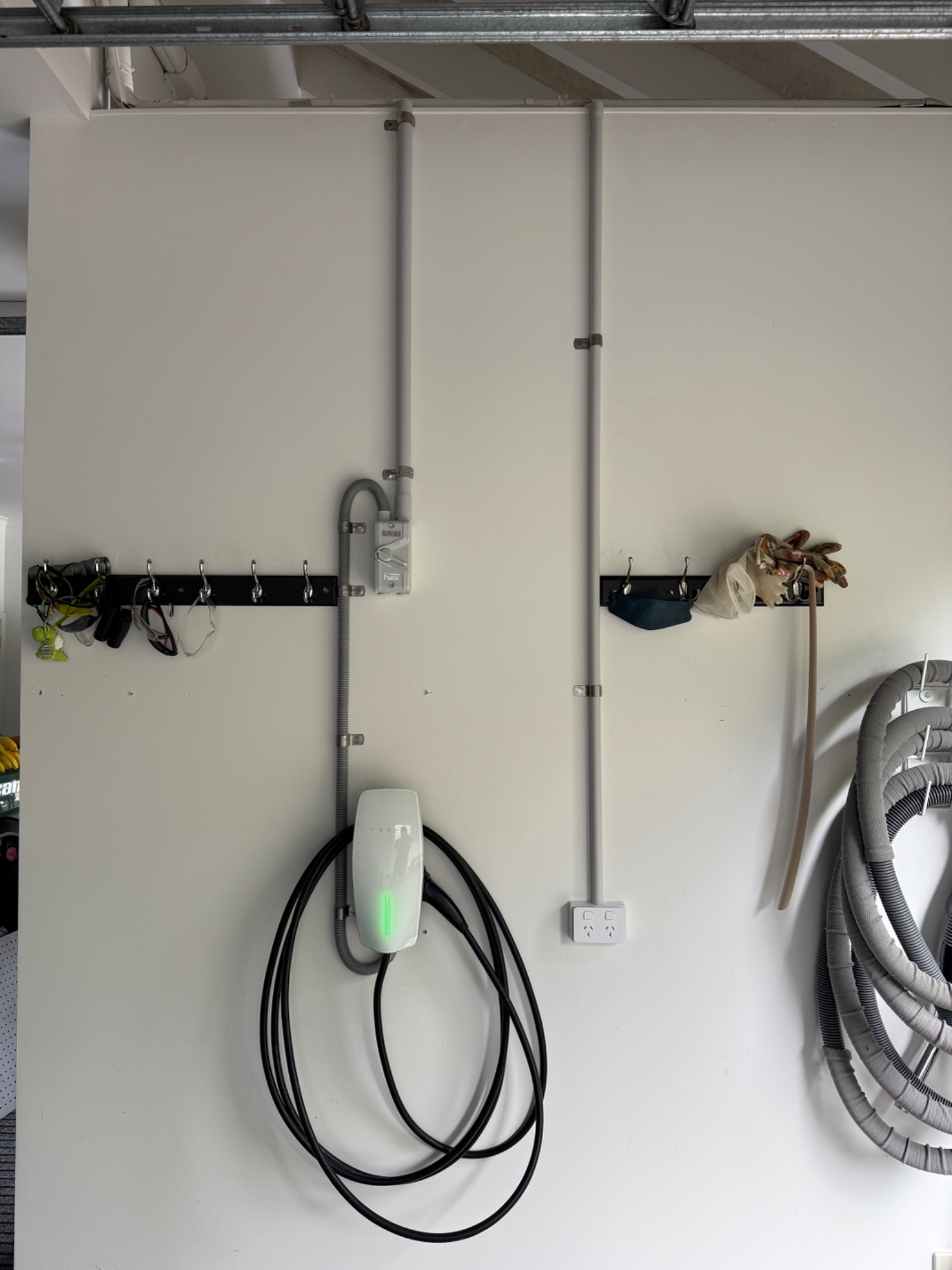
What the installation covers
EV charger installation, at a home or a workplace, includes the circuit that feeds the charger, not only the electric car charger itself. The job covers:
- a dedicated circuit from the switchboard to the charger
- the protection for that circuit, including its RCD, as the charger's instructions and WorkSafe's charging guidelines set out
- a lockable isolating switch for the charging circuit
- the cable run from the switchboard to the parking space
- mounting and connecting the charger
- a switchboard upgrade if the board has no room for the new circuit
- testing, and the certificate for the work
What we need to know
- the car, and the charger model and its installation manual if you have already bought one
- where the switchboard is, with a photo of it with the door open
- where the car parks, and roughly how far that is from the switchboard
- a photo of the wall or post where the charger will go
- for a workplace: how many chargers, where the cars park and where the building's switchboard is
The home EV charger checklist goes through these points before a charger is chosen.
How an EV charger job runs
- You send the details above with the photos, or we visit.
- We list the work: the circuit, the cable route, the charger position and any switchboard change.
- You confirm the charger position, the list and the quote.
- We run the circuit, then mount and connect the charger.
- The circuit is tested before the charger is switched on.
- You receive the certificate when the charger is handed over.
RCD protection for the charging circuit
For a charger at a home, WorkSafe's January 2026 addendum to the Electric vehicle charging safety guidelines says the charging circuit shall be protected by a Type B RCD and shall start from a MEN switchboard. It allows two alternatives to a separate Type B RCD: an RDC-DD complying with IEC 62955 used with a Type A RCD, or a charger with a Type B RCD built in. WorkSafe also notes that the Type A RCDs already installed in many houses are not suitable to protect against all the faults an EV or its charging equipment may give.
The guidelines add that every circuit supplying a charging station should include a lockable isolator that operates in all live conductors, including the neutral, and that a charging station should not be connected to the supply with a plug and socket. They list socket-outlet adaptors, two or more supply leads joined together, extension leads and portable socket-outlets as unsafe practices.
The switchboard and the supply
Whether the switchboard and the supply can take a charger is settled before the quote. For a 32 A socket-outlet used with a portable charger, WorkSafe's 2026 addendum notes that a home is unlikely to have been designed for an additional, steady 32 A load: an assessment of the maximum demand is necessary, and some form of load management is recommended.
WorkSafe also says that, depending on its age, a home's wiring may need to be upgraded or new wiring installed before a charger is added, because high demand can be a fire risk with older wiring that is not designed to cope with it. Where that applies, the circuits concerned are listed for rewiring in the same quote.
Put a heat pump circuit or any other new circuit on the same list, so the board and the supply are checked for all of them at once.
Where the charger goes
At home, the charger is placed so its cable reaches the car's charge port without lying across a path. Its position and the cable route to it are agreed with you before the quote.
Home EV charger installation
For a home EV charger installation, the circuit runs from the house's switchboard to where the car parks, and the charger goes on the wall or post you choose. We install home chargers across Auckland, from the North Shore to South Auckland; the suburbs are listed under our service area.
If a work vehicle needs to be charged at home for business purposes, WorkSafe's addendum says a dedicated charging station should be installed, and that the charging station and its protective devices should be tested for safety and function every year, with the outcome recorded.
Workplace EV chargers
Workplace chargers are planned with the building's switchboard and the number of parking spaces that need charging, now and later. Both are settled before the quote, because several chargers may need a sub-board or changes to the main switchboard. This is part of our commercial electrical work. In non-domestic premises, WorkSafe's guidelines say a charging station's circuit should be protected by an RCD providing personal protection.
FAQ
Can you install a charger I have already bought?
Yes. Send us the make and model with its installation manual; the circuit, cable and protection are chosen to match it. WorkSafe warns never to use damaged or modified charging equipment, such as overseas equipment that has been fitted with a New Zealand plug.
Will my switchboard need an upgrade?
Not always. It depends on whether the board has room for the new circuit and its protection, and whether the supply can carry the extra load. A photo of the board usually answers the first question; the second is checked on site.
Can an EV charger be installed outside?
Yes. WorkSafe's guidelines say charging equipment installed or used outdoors, or in a damp location, should have a degree of protection of at least IPX4, so the charger's rating is checked against its position before the quote.
What does the dedicated circuit do?
It supplies the charger alone, so charging does not share a circuit with other sockets or appliances. WorkSafe's guidelines say a charging station in a home should be supplied from a dedicated final sub-circuit.
Can any electrician install an EV charger?
It has to be a registered electrician: WorkSafe says a wall-mounted charging unit, at home or in a workplace, must be installed by one. Its charging guidelines tell those who use them not to install, test, certify, inspect or connect a charging station unless they are competent to do so, licensed for prescribed electrical work and have the correct equipment. EWRB's guidance on the homeowner exemption lists electric vehicle charging among the areas where homeowners may not do wiring work.