
 Open Client Check
 Open COC / ESC
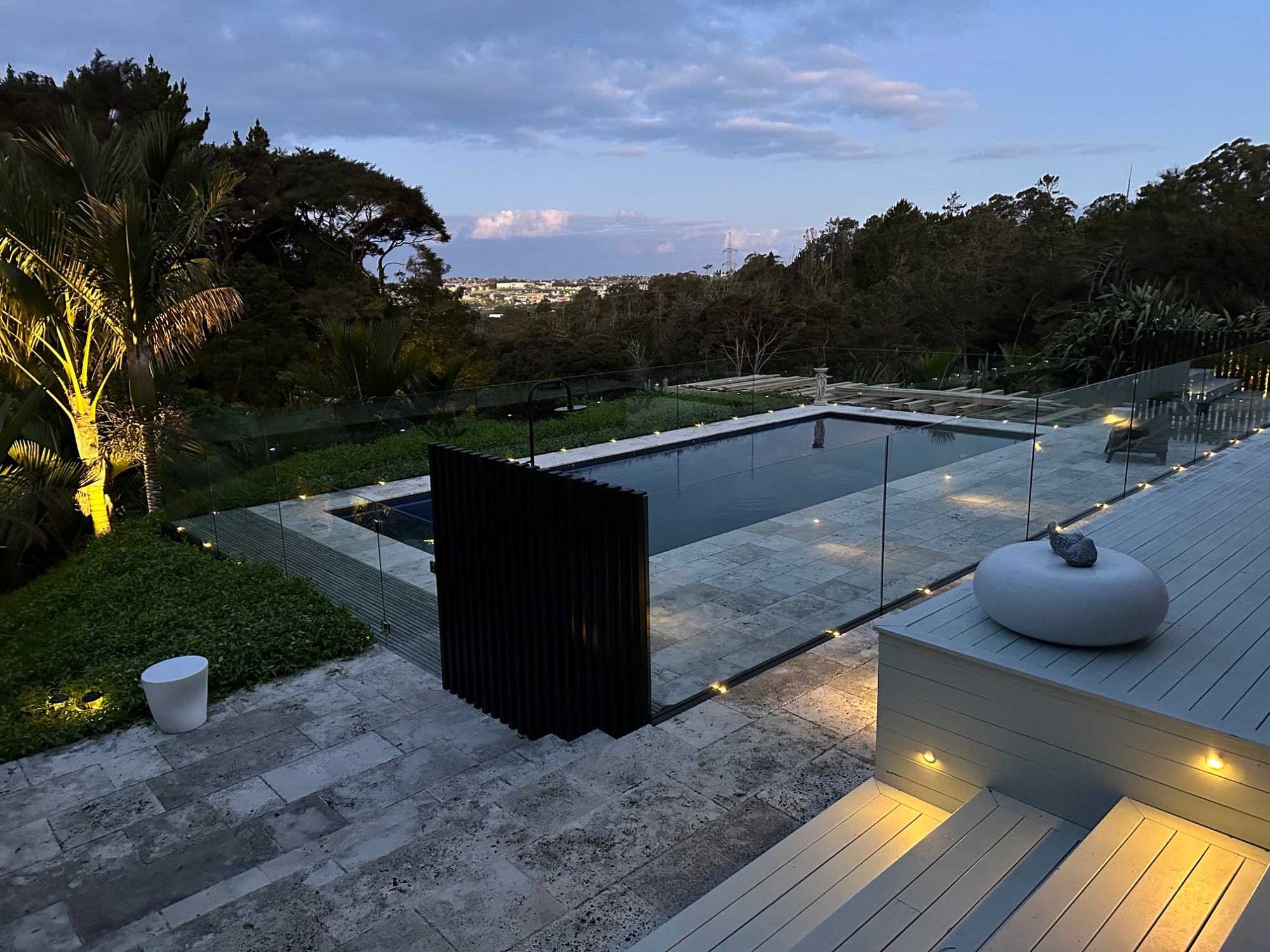
To add outdoor lighting, decide what each area needs light for and how the lights turn on, then have an electrician run the circuit and fit the lights. It is easiest while the landscaping is under way, when cables can still go under the paths, patios and lawns, and the lights are fitted once those surfaces are finished. In Auckland, our outdoor lighting work covers path, step, deck, garden and outdoor wall lights, sensor lights and outdoor sockets.
What to light, area by area
Outdoor lights are planned area by area.
| Area | What we install | What you decide |
|---|---|---|
| Driveway and entrance | Sensor lights and low lights along a fence | Which lights a motion sensor turns on, and which a switch or timer controls |
| Paths and steps | Path and step lights | Which paths and steps are lit, and where each fitting is mounted |
| Decks, including around a pool | Lights set into the boards, the steps or the posts | Which boards, steps and posts take a light, before the decking is finished |
| Garden | Lights for trees, hedges and planting | Which trees and plants are lit, and the effect you want |
| Outside walls | Wall lights by doors, garages and gates, and fittings under the eaves | Which lights switch together, and where the switch inside goes |
| Outdoor sockets | Sockets for garden tools, pumps and seasonal lighting | Where each one goes, so nothing has to run from an extension lead |
Our garden lights project shows several together: low lights along a driveway fence, deck lights around the house and step lights on a pool deck, uplights on trees, palms and ferns, and lit paths and boardwalks.
Switches, timers and sensors
Decide which lights work together, and what turns each group on:
- a switch inside the house
- a timer
- a light sensor that turns them on at dusk
- a motion sensor
Outdoor lights can be put on a timer or a sensor alone, or keep a switch inside as well; each timer and sensor is set when the circuit is tested.
Fittings and 12 V lights
Each outdoor fitting has to suit how it is mounted: in the ground, on a post, on a wall or under the eaves. Extra-low voltage lights, such as 12 V garden lights, take their power from a transformer. Its place is chosen to stay dry, close to the lights and easy to get at later, and a switch or timer of its own controls its supply.
Planning outdoor lighting with the landscaping
- Timing: the landscaping programme sets the dates, because each cable goes in before the surface above it is laid.
- Records: photos of the cable routes, taken while they are still uncovered, let anyone who digs there later find the cables.
On a new build, our first stage after the plans is the penetrations, where cables pass through the outside walls, among them those for the outdoor lights and outdoor sockets, so their positions are settled on the plans first. The later stages are set out in new build electrical stages.
The circuit, sockets and RCD protection
Outdoor lights and sockets go on a circuit from the switchboard, planned with its protection. WorkSafe lists garages, pools and external electric outlets among the damp areas of a home with electric fittings where residual current devices, or RCDs, should be installed. An RCD watches the current on its circuit and cuts the supply as soon as it senses a loss of current. When the switchboard has no room for a new circuit, a switchboard upgrade is listed and quoted with the lights.
If garden lights, a pump or seasonal lighting run from an extension lead now, WorkSafe says extension cords are intended for temporary use only, and that one used outside should always be protected by an RCD or an isolating transformer. It warns that frayed, cracked or damaged cords may result in fire or an electric shock. Where a permanent power source is needed, WorkSafe's advice is to have a licensed electrician install a socket; outdoor power points are listed and quoted with the lighting.
Can I install outdoor lights myself?
A new circuit from the switchboard is prescribed electrical work: the Electricity Act 1992 allows it to be done only by people it authorises, such as a registered electrical worker with a current practising licence, or under its exemptions.
The homeowner exemption, in section 79 of the Act and regulation 57 of the Electricity (Safety) Regulations 2010, lets an owner who lives in the house do a set list of unpaid work, such as replacing light fittings and socket-outlets where no switchboard work is involved, done and tested to the homeowner wiring code, NZECP 51. New or altered circuits are allowed only without entering any enclosure where live conductors are likely to be present, and EWRB, the Electrical Workers Registration Board, says this wiring must be tested, certified and connected by an Electrical Inspector. EWRB states that the exemption excludes rental properties, and WorkSafe does not recommend doing your own electrical work unless you have the necessary skills and knowledge.
How we work, and what to send
For a home in Auckland, send a landscape plan, or photos of each area with the lights marked on them, or we come and look. Tell us where the switchboard is and how a cable can reach the garden from it, which fittings you have chosen or the effect you want in each area, and when the landscaper will lay any paths, paving or decking still to come.
- Every light, switch, sensor and outdoor socket goes on the list for its area, together with its cable route.
- The timing is set with you or your landscaper after you confirm the list and the quote.
- Each circuit is tested and the timers and sensors are set before you receive the certificates.
FAQ
Can you install outdoor fittings I have bought?
Yes. Either you or we supply the fittings, as agreed on the quote. If you buy them, send the model or its specifications, and have them on site, marked by area, before they are installed.
Can I do the wiring for a pool or water feature myself?
Not as a homeowner, according to EWRB. Its guidance on the homeowner exemption lists the electrical installations of swimming pools, paddling pools, spa pools, fountains and water features among the areas where homeowners may not do wiring work.
Will I get a certificate for new outdoor lights?
Yes. New circuits, sockets and light points wired from the switchboard are fixed wiring work, and WorkSafe says electricians must issue a Certificate of Compliance for any fixed wiring work; you also receive an Electrical Safety Certificate once the work is connected. Replacing an existing outdoor fitting is low-risk work, for which the regulations make a Certificate of Compliance optional.
What if outdoor lights trip the power, or a fitting gives a tingle?
If a breaker or RCD trips again as soon as it is reset, leave it off, and note whether it happened in wet weather. WorkSafe says to call a licensed electrician if a circuit-breaker continues to trip, and that a tingle from a light is usually a warning of danger. After any electric shock, WorkSafe says to seek medical treatment and advice immediately, even if the person feels fine. Fault finding traces the cause by testing: an insulation resistance test shows damaged or damp cables and fittings.