
 Open Client Check
 Open COC / ESC
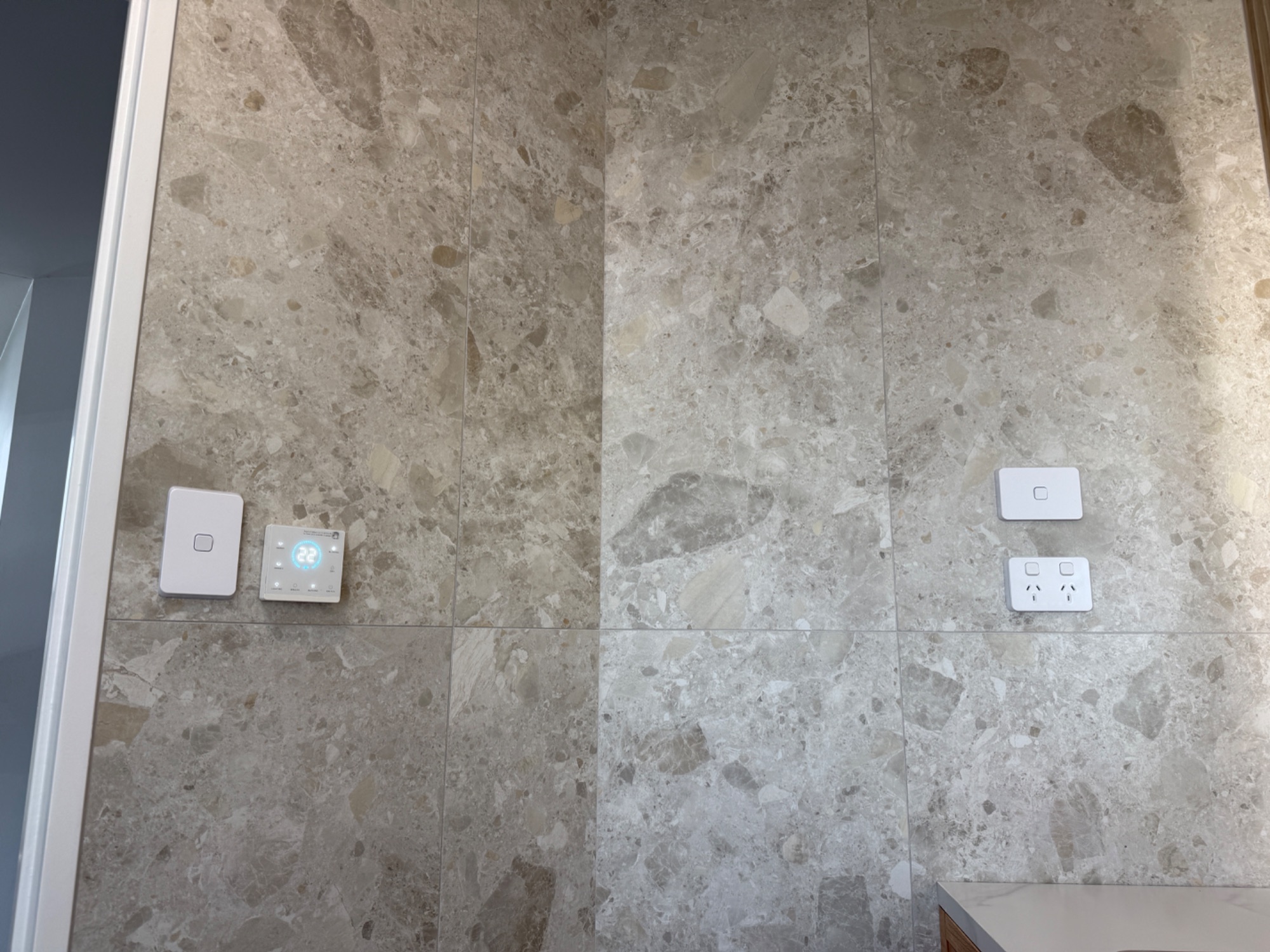
Power point installation is planned around what will be plugged in at each wall. We list every new, moved and replaced socket and switch room by room, with the circuit it goes on, and you confirm the list before work starts.
What power point installation covers
- new power points: single and double sockets, sockets with USB outlets, and outdoor sockets
- points moved to suit new furniture, kitchen and bathroom layouts
- worn, cracked, loose or scorched sockets and switches replaced
- light switches added, moved or replaced
- extra sockets where multi-boxes and extension leads are in use now
- the circuit for each point: an existing circuit nearby, or a new circuit from the switchboard
How a power point job runs
- Tell us what you need room by room and send a photo of each wall where a point goes, or we visit.
- We list every point, new, moved or replaced, with its room, wall, height and circuit.
- You confirm the list and the quote before work starts.
- Cables run inside the walls and ceilings or under the floor; where a cable cannot run inside a wall, the route is agreed with you first.
- Each point and circuit is tested before the power goes back on.
- New wiring is certified, and you receive the certificate when the work is finished.
The photos that help are listed in before you call an electrician. We install power points in homes across Auckland, from the North Shore to South Auckland; see our service area.
Planning where points go
Think about what will be plugged in at each wall, and at what height:
- Living areas: the TV wall, lamps, and where phones and laptops charge
- Bedrooms: each side of the bed, and the desk
- Kitchen: along the bench and on the island, where the appliances are used
- Laundry and garage: the washing machine, a freezer, tools and a workbench
- Outside: outdoor power points for garden tools, a pump and seasonal lighting
WorkSafe says heaters, electric jugs, washing machines and stoves should be plugged directly into a wall socket rather than a multi-box, so plan a wall socket wherever one of these is used. Kitchen and bathroom points are planned from the cabinet and bathroom drawings under kitchen and bathroom electrical, and points moved in a renovation go on the same room-by-room list, as on all our residential electrical work.
Multi-boxes, extension leads and worn sockets
WorkSafe notes that multi-boxes are often used in older houses, where a room sometimes has only one socket-outlet, and that a permanently installed four-way switched socket-outlet removes the need for multi-boxes and extension cords. It says extension cords are intended for temporary use only, and that where permanent power is needed, a licensed electrician should install a socket. It also says poor electrical contact and overloading are a major cause of electrical fires.
Plugs and sockets that are hot to the touch or have brown scorch marks are among the warning signs WorkSafe lists for an installation that is becoming dangerous, and its advice is to have a licensed electrician or electrical inspector check the wiring. A damaged socket is replaced and its circuit tested; sockets with no power are traced through fault finding.
The circuit and RCD protection
Each new point is connected to an existing circuit nearby, or to a new circuit from the switchboard. WorkSafe states that it is a legal requirement for all new circuits from the switchboard supplying lighting or socket-outlets in domestic buildings to have RCD protection. An RCD, or residual current device, can be built into a socket-outlet or wired into the switchboard, and WorkSafe says RCDs should be installed in damp areas of a home where there are electric fittings, such as bathrooms, laundries, kitchens, garages and external electric outlets. When the switchboard has no room for a new circuit, a switchboard upgrade is listed and quoted with the points.
FAQ
Will I get a certificate for a new power point?
Yes. A new power point is fixed wiring work, and the Electrical Workers Registration Board says electrical workers must issue a Certificate of Compliance for it. Replacing an existing socket is low-risk work, for which the regulations make a Certificate of Compliance optional.
Does a new circuit for power points need RCD protection?
Yes. WorkSafe states that all new circuits from the switchboard that supply lighting or socket-outlets in a home must, by law, have RCD protection. WorkSafe also says RCDs should be installed in damp areas of a home where there are electric fittings, such as bathrooms, laundries, kitchens, garages and outdoor outlets.
Can you add a power point to an existing wall?
Usually. The cable runs down inside the wall from the ceiling space, or up from under the floor. Where that is not possible, the route is agreed with you before the point goes on the list.
How do I test an RCD socket?
WorkSafe's advice is to plug in a small appliance and press the "test" button: if the appliance turns off, the RCD is working. It suggests testing these RCDs regularly, for example every three months. The homeowner code of practice, NZECP 51, says never to use an RCD whose test button fails to turn it off, and to seek advice from a licensed electrical worker, as the RCD may need replacing.